For parliaments and organizations
Two paths. Neither requires coding.
The library or research service of a parliament
“What was said here about this, who said it, and from which party or parliamentary group?”
If your Record is in one PDF per session, answering costs an afternoon. Here it is in one table: the plenary of your chamber, full text, from the start of its series. And, in the same format, the plenary of the other chambers, one by one.
Three steps, no coding
Choose your chamber. Of the 17 files, you need one: the one that ends in
_interventions.csv.Download from DataverseOpens in Harvard Dataverse.
- Portugal Assembleia da República 1.1 GB file
- Spain Congreso de los Diputados 1,009 MB file
- Ecuador Cámara Nacional de Representantes / Congreso Nacional / Asambleas Constituyentes / Asamblea Nacional 1.1 GB file
- Argentina Cámara de Diputados de la Nación 841 MB file
- Uruguay Cámara de Representantes 929 MB file
- Mexico Cámara de Diputados 1.5 GB file
- Paraguay Cámara de Diputados 252 MB file
- Chile Cámara de Diputadas y Diputados 957 MB file
- Costa Rica Asamblea Legislativa 655 MB file
- Peru Congreso de la República 798 MB file
- Panama Asamblea Nacional (Legislativa hasta 2004) 465 MB file
- Colombia Cámara de Representantes 483 MB file
- Guatemala Congreso de la República 269 MB file
- Dominican Republic Cámara de Diputados 523 MB file
- Brazil Câmara dos Deputados 1.4 GB file
- El Salvador Asamblea Legislativa 98 MB file
Do not open it with a double click. Go to the explorer, click “Elegir archivo…” (Choose file…), and select it. When you choose it, the explorer tells you how much memory it needs. On a modest computer, try El Salvador first (98 MB). Open the explorer
The explorer opens one country at a time, is in Spanish only today, and requires a recent browser.
The explorer's interface is in Spanish only today. Search runs on each chamber's original text, in Spanish or Portuguese.
Search for a word or a phrase; filter by date, party, legislature (the term each Record prints), and deputy; export the result with its citation.
Nothing leaves your computer: the file opens in your browser, not on a server.
What it is not
Neither an official record nor a substitute for the Record. Derived edition for research: in case of any discrepancy, your chamber's Record prevails. Before citing a passage, find it there by date and session number.
It does not cover committees or the Senate, it does not include votes as data, and it does not reach the current year. Your country page says where the series ends and which years are missing. View the countries
The international organization
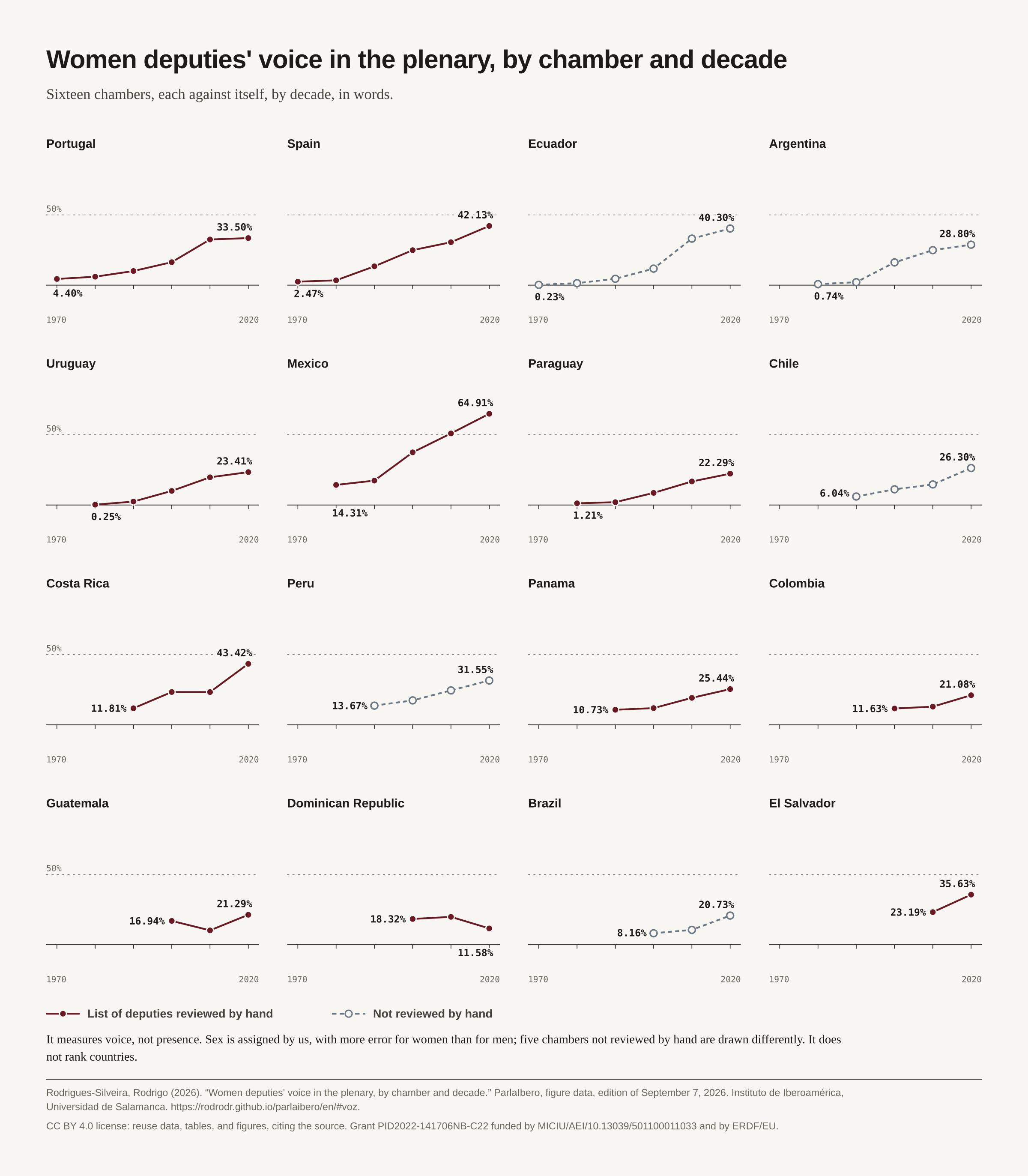
“We have seats by sex. How much of what is said in the plenary is said by women?”
What you take, without downloading the corpus
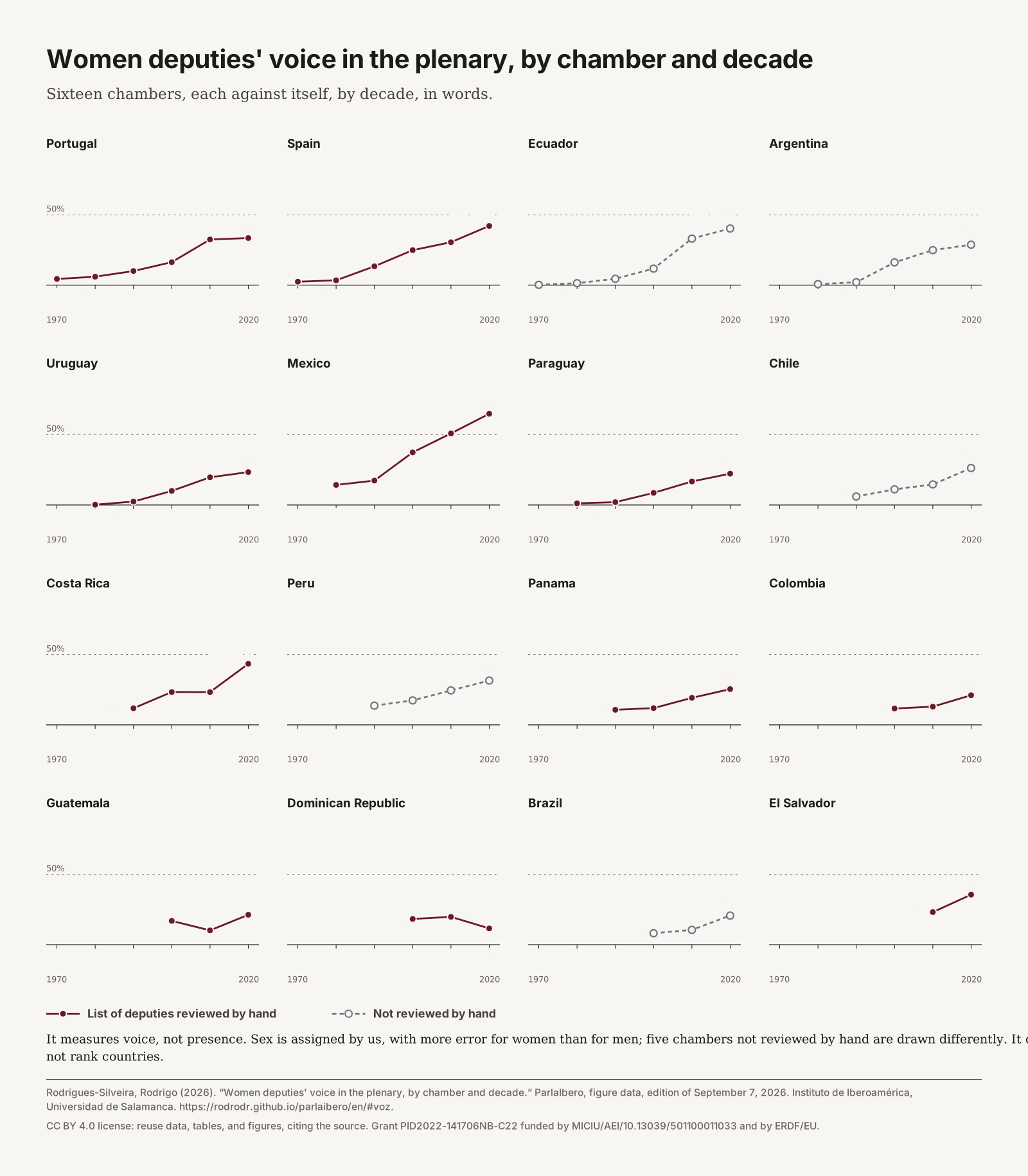
A table of indicators by chamber and decade, in CSV and Excel. Each value carries its n and its denominator, in words. Each decade states how many chambers there are: from three in the first to sixteen in the last. The README says what each column measures.
Download the table Download the image
voz_por_camara.xlsxvoz_por_camara.csvleame-voz_por_camara-en.txtvoz_por_camara-en.pngvoz_por_camara-en.svg
How to read it
It measures voice, not presence: read it alongside your series on seats. It is not an official indicator, and it does not rank countries. Sex is assigned by us, with more error for women than for men. The table marks the five chambers whose list of deputies was not reviewed by hand.
How to cite a figure
With authorship, year, edition, and date. Each figure has its citation ready:
Rodrigues-Silveira, Rodrigo (2026). “Women deputies' voice in the plenary, by chamber and decade.” ParlaIbero, figure data, edition of September 7, 2026. Instituto de Iberoamérica, Universidad de Salamanca. https://rodrodr.github.io/parlaibero/en/#voz. Accessed [date of your access].
Who makes it
A data infrastructure for the social sciences and humanities: the same 16 columns in all sixteen chambers, one DOI per country, and editions that do not change.
The Instituto de Iberoamérica of the University of Salamanca, with the coauthors of each country page.
CC BY 4.0 license: reuse data, tables, and figures, citing the source.
Each country has its DOI in Harvard Dataverse. A published edition does not change: anything new is published under another number. Identifiers are stable within an edition, not across editions.
Want the same format for your committees or for another chamber? The method is published and open. View the tools
Not sure where to start? Write to us